

By Marisa de la Villa
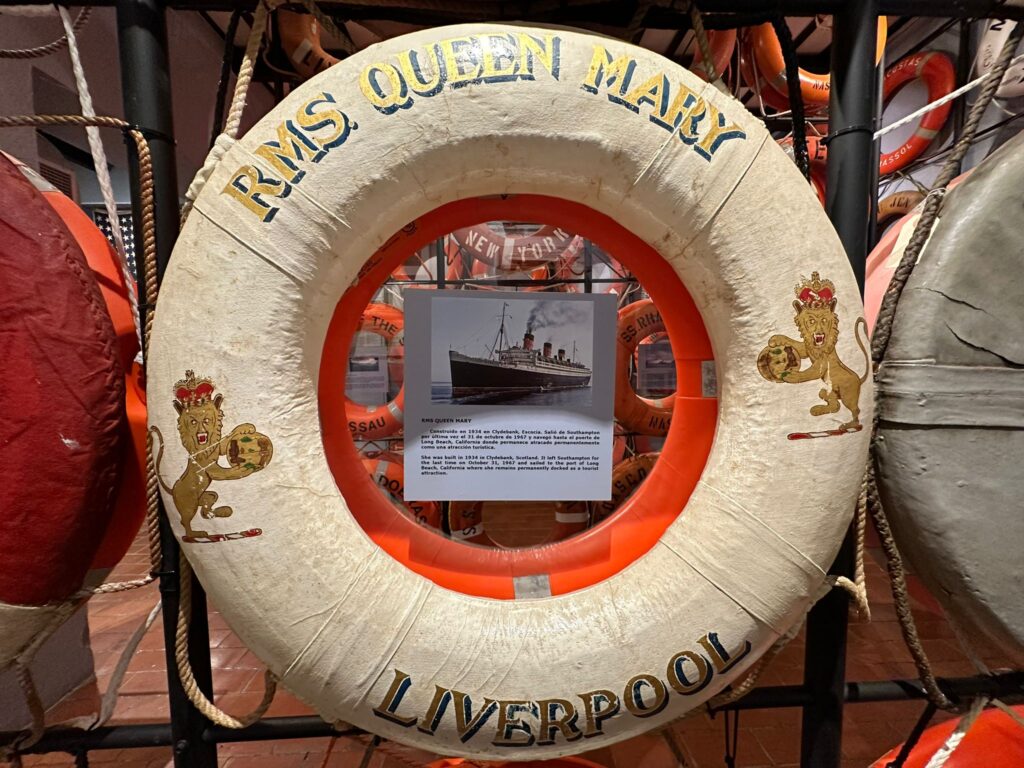
Queen Mary Lifering, Museo del Mar, Old San Juan, PR.
In the heart of Long Beach, California, the RMS Queen Mary stands as a vessel through which we are able to immerse ourselves in the golden age of ocean liners, while simultaneously allowing us to explore the paranormal world we seem to be so enamored with today. Since its launch in 1934, the Queen Mary has lived up to its name, gaining popularity and having hosted and ferried many rich and famous people across international waters. The famed ship served as a passenger liner for a limited period, before being transformed into a WWII troopship for allied soldiers.1
Today, the Queen Mary is not only known for its historical significance, both as an ocean liner and for its participation in WWII, but also for its reputation as one of the top haunted locations in the world, and top ten in America (as voted by Time magazine). How exactly did a ship of such elegance and prestige find itself as the center of mass amounts of paranormal activity? The Queen Mary’s transition from its days of service to its current status as an active site for supernatural occurrences unveils a rich history that is still being discovered to this day. From artifacts, to closed off rooms, to major hauntings, the Queen Mary holds an incredible history.2
Many of those who believe in possessions and hauntings believe that specific artifacts taken from the site may carry with them that very haunted energy. Located in the Calle San Francisco at Old San Juan is a gem: Puerto Rico’s Maritime Museum. Within our vast collection of nautical objects and display of maritime history, you’ll find key objects, such as a lifebuoy, from this very haunted ship. You’ll have to visit us and let us know what you think– is this artifact really haunted?
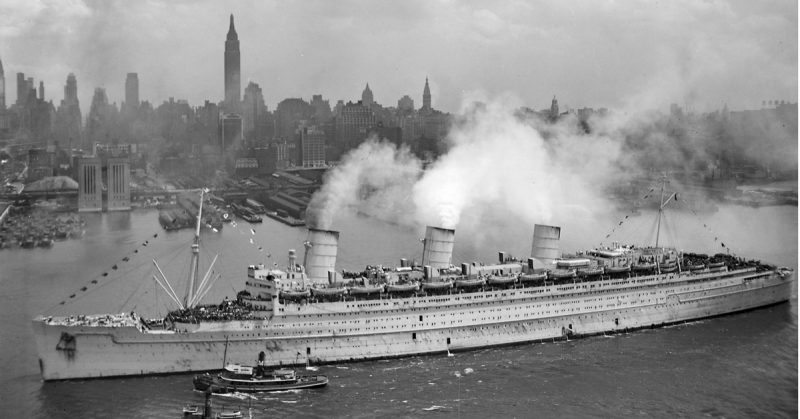
Queen Mary on 20 June 1945, New York.
II. RMS Queen Mary Timeline
[2.1] Creation
In the late 1920s, the Cunard Line was faced with some major issues. One, their current fleet of ocean liners was old, and it was showing. Two, the increasing competition was fierce, with rival companies like the Compagnie Générale Transatlantique, typically known overseas as the French Line, constantly building and sending out prominent vessels. Cunard’s response was, as expected, to construct more ships, and make them of a bigger and better quality. With this came the RMS Queen Mary.3
Construction on the Queen Mary began in Clydebank, Scotland, in 1930, but was discontinued for two years because of the Great Depression. The ship was eventually launched in 1934, starting its career as one of the greatest ocean liners of all time. On May 27, 1936, the Queen Mary embarked on its maiden voyage, traveling from Southampton, England, to New York City, a trip which took around five days.4
The Queen Mary was known for its comfort and elegance– its amenities including two swimming pools (separated by class), a gymnasium, a hospital, and a library.5 One of the ship’s most famous facilities was its grand ballroom, which, even today, tends to be a hotspot for current tourists and paranormal investigators alike. With all its grandeur and luxurious air, the ship had set a new benchmark in transatlantic travel, something which, at the time, had been considered the only civilized way to travel by the rich and famous. Throughout its time as a liner, the Queen Mary carried with it many different people from all sorts of backgrounds; notably, Prime Minister Winston Churchill, the Duke and Duchess of Windsor, and famous Hollywood actors like Audrey Hepburn, Clark Gable, and Fred Astaire, among others.6
[2.2] World War II
When World War II started in September 1939, the Queen Mary had been making its way to New York City. The Queen Mary then dawned a new identity: the Grey Ghost, which was officially launched as a troopship on March 21, 1940, making its way toward Australia. This new version of the Queen Mary was reportedly the fastest and largest, reaching a speed of 32.5 knots (which is faster than many German U-boat torpedoes). The ship underwent serious transformations to reach this new status as a troopship, having been refitted to both hold more people and prevent it from being an easy target for German ships, as well as being painted in a gray camouflage to avoid being noticed easily.7
In 1943, the ship set a record for carrying the most passengers with 16,683 people– 943 being crew members and 15,740 being troops. However, though it was known as one of the largest and most successful ships in the war’s marine front, tragedy still struck. In October 1942, the ship had collided with escort ship HMS Curacoa, in a fatal accident, near the coasts of Ireland. The Queen Mary, being around 20 times larger, sliced through the cruiser, killing over 300 people.8
[2.3] Hotel and Museum
After the war, the Queen Mary had initially resumed its career as a liner, carrying on with its trips from England to New York, and back. It enjoyed huge popularity until around the 1960s, when airplane travel became the normative means of transportation. To combat this sudden loss in popularity, the Queen Mary added new routes, including a Mediterranean cruise. In 1966, however, Cunard announced that it was selling the ship, which was bought by the city of Long Beach, California, for $3.45 million dollars.9
Since her retirement as an active liner in 1967, the Queen Mary has gained incredible fame as an iconic Long Beach attraction, hotel, and venue for special events. The ship carried over 2 million passengers in peacetime, and over 800,000 military personnel during World War II. However, at its permanent dock in Long Beach, an estimated 50 million people have visited the Queen Mary. On November 2, 1972, the first 150 hotel rooms were opened, beginning a new era for the Queen Mary– one full of guests from all over the world, increasingly curious toward the ship’s history and paranormal activity. The day the ship was launched, in 1934, English psychic Lady Mable Fortiscue-Harrison spoke these legendary words, which predicted the ship’s future entirely: “The Queen Mary will know her greatest fame and popularity when she never sails another mile or carries another fare-paying passenger.”10
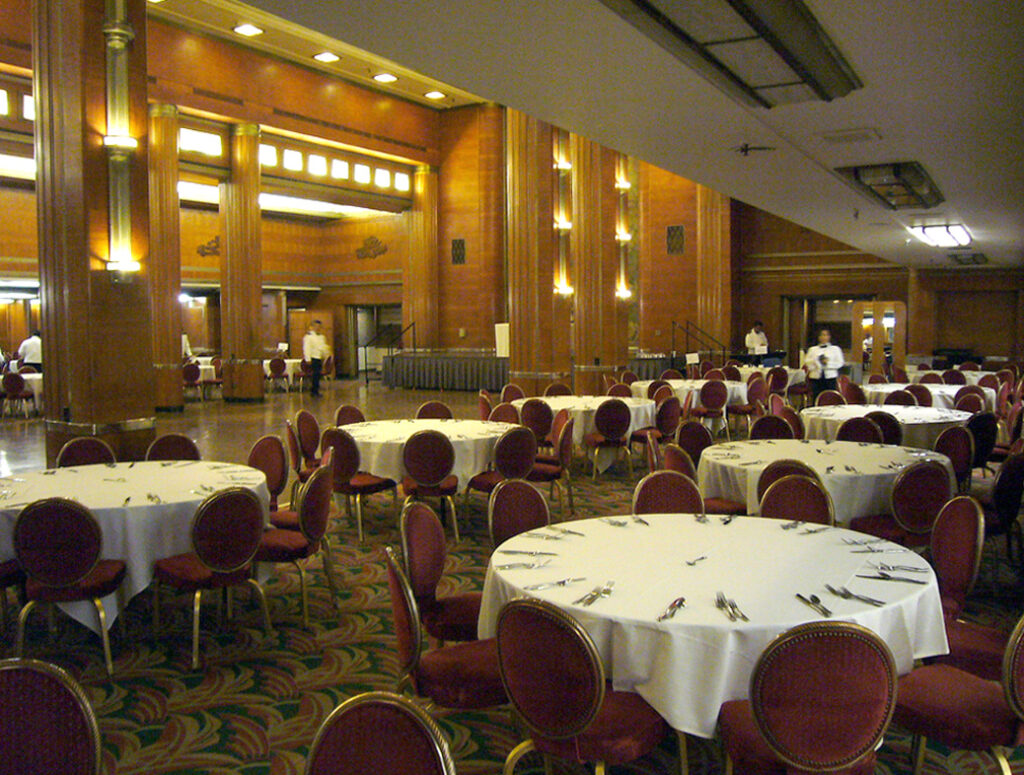
RMS Queen Mary Grand Salon
III. A Long History of Haunted Sightings
Stories of odd sightings, eerie vibes, and suspected hauntings began to arise almost immediately after the Queen Mary was permanently docked in California. Those working to prepare her for her permanent dock would mention seeing strange figures out of the corners of their eyes or would hear full on conversations while nobody was around. Tools would disappear and be found at complete opposite ends of the ship. Reports of knocking, temperature changes and flickering lights have amassed over the years.
Though the exact reason for why so many spirits reside in the Queen Mary is unknown, it is believed that many of its permanent residents are aware that their days at sea are over, and are quite unhappy about it. Others speculate this displeasure came from the destruction of the ship in its transformation into a tourist attraction. Either way, people believe the spirits residing in the Queen Mary aren’t happy, though some share their moodiness more openly than others. The exact number of how many spirits there are aboard this ship is unknown; the late psychic Peter James once said there were at least six hundred.11 Though we can’t exactly take into account every detail of every single haunting, here are some of the most well-known:
[3.1] The Queen’s Salon – The “woman in white”
A “woman in white” is a common figure seen in many haunted locations around the world– though each one has her own distinct story. The Queen Mary is no different. Usually, a woman in white is described as a wandering female apparition, dressed in a flowing white gown. Witnesses have reported seeing the fleeting figure of a woman wearing an elegant white gown, somewhat reminiscent of the clothing worn by passengers in the 1930s and 40s. She’s often seen dancing alone in the Grand Salon, almost as if she were reliving a memory of a grand ball. Though the real identity of this woman in white remains a mystery, it is believed she was once a passenger on this grand ship, and met her end while aboard it.12
[3.2] The Engine Room – John Pedder
On July 10, 1966, tragedy struck by watertight door #13 in the engine room. John Pedder, an 18-year-old crew member was crushed to death when going through an emergency drill. The watertight doors were closing automatically. Pedder tried to squeeze through, but he didn’t make it. Since then, multiple people have reported sightings of a figure lurking, in overalls, “tinkering in the engine area.”13 Reports of unexplained knocking by door #13 as well as finding greasy handprints in the area have been frequent. One couple in particular, back in 1991, were convinced they had come into contact with the spirit of John Pedder during their stay, claiming they felt like they were being watched as they walked through the engine room. Allegedly, the husband felt something brush against his cheek, but thought nothing of it at the time. However, once they’d left the engine room, his wife had noticed a patch of grease staining his cheek.14
[3.3] Room B-340
Shut down due to increasing paranormal activity, room B-340 has made a name for itself as the most haunted space on the Queen Mary. Guests have reported feeling watched, being touched and/or scratched, things turning on and off randomly, seeing apparitions, and poltergeist activity. Some guests even reported a man’s voice screaming for them to “get out.” The story goes that a family was brutally murdered in this room, and their spirits are so restless– whether out of fear or need for vengeance is unclear– the room had to have been shut down. Only recently has it reopened to the public, back in April 2018.15
Though many question these stories, pointing out how they are all likely a ruse to get people to stay in these rooms, the sheer number of paranormal investigations that have happened in B-340 alone suggest some sort of presence resides in this room. Even if the stories of murders and other atrocities committed in this very room are untrue, multiple accounts of a dark, and almost demonic presence, are strong in the legends of the Queen Mary.

RMS Queen Mary, 2008
IV. Conclusion
Whether or not the ship is haunted truly depends on where you stand on the paranormal– do you believe in ghosts? Is it possible for people who once roamed this Earth to still be with us, though not physically? Hundreds of thousands of people claim they truly have experienced the paranormal world of the Queen Mary. Others argue it is merely a ploy to get attention and money. Regardless of which is true, one thing is undeniable: Lady Mable Fortiscue-Harrison was absolutely correct. The RMS Queen Mary has never been more popular than it is today. The ship is not only a place for people to claim they have or haven’t interacted with the paranormal– it is a relic of time, a piece of history that still stands with us today. And that is something that should be celebrated.
If you are wanting to find out if there is even a possibility of residual haunted energy, come and visit our “definitely haunted” lifebuoy from this very ship. Within our vast collection of relics (and Guiness World Record of Lifebuoys), we guarantee you will find at least one haunted item.
About the Author
Marisa de la Villa is currently in her third year at Boston University, where she expects to graduate with a Bachelor’s degree in History. From a young age, she has enjoyed the sea, spending summers on her grandfather’s sailboat. She obtained her diving license at the age of 10 and her navigation license at 15. As a history student, she understands the importance of ships throughout time. Marisa is currently volunteering at the Museo del Mar in San Juan, Puerto Rico.
Notes
- City of Long Beach “A Trip Across Time: History of the Queen Mary.” Last great cruise timeline.
- City of Long Beach “A Trip Across Time: History of the Queen Mary”
- Amy Tikkanen, “Queen Mary,” Encyclopædia Britannica, June 27, 2024
- Tikkanen, “Queen Mary,” Encyclopædia Britannica
- Tikkanen, “Queen Mary,” Encyclopædia Britannica
- City of Long Beach “Famous People Aboard the Queen Mary” Fun Facts of the Queen Mary.
- Tikkanen, “Queen Mary,” Encyclopædia Britannica
- Tikkanen, “Queen Mary,” Encyclopædia Britannica
- Tikkanen, “Queen Mary,” Encyclopædia Britannica
- City of Long Beach “Long Beach Years” Queen Mary Timeline.
- Brian Clune and Bob Davis, Ghosts of the Queen Mary: Haunted America (Arcadia Publishing, 2014), Chapter 6
- Clune and Davis, Ghosts of the Queen Mary: Haunted America, Chapter 6
- Clune and Davis, Ghosts of the Queen Mary: Haunted America, Chapter 6
- Terry Spencer, “Tour of Queen Mary’s Ghosts : Past Said to Haunt Giant Ship,” Los Angeles Times, March 11, 1988,
- Brian Clune and Bob Davis, Ghosts of the Queen Mary: Haunted America (Arcadia Publishing, 2014), Chapter 7
Bibliography
City of Long Beach “A Trip Across Time: History of the Queen Mary.” Last great cruise timeline. Accessed July 10, 2024. https://queenmary.com/history/stats-fun-facts/last-great-cruise-timeline/
City of Long Beach “Famous People Aboard the Queen Mary” Fun Facts of the Queen Mary. Accessed July 10, 2024 https://queenmary.com/history/stats-fun-facts/celebrities/
City of Long Beach “Long Beach Years” Queen Mary Timeline. Accessed July 15, 2024
https://queenmary.com/history/timeline/long-beach-years
Clune, Brian, and Davis, Bob. Ghosts of the Queen Mary: Haunted America. Arcadia Publishing, 2014.
Green, Ronald. “Warrior Queens: RMS Queen Mary and RMS Queen Elizabeth in the Second World War. (History).” Booklist, vol. 98, 1 Jan. 2002, pp. 798+. Gale Academic OneFile, Accessed 12 July 2024. link.gale.com/apps/doc/A82513302/AONE?u=mlin_b_bumml&sid=bookmark-AONE&xid=4122c
Spencer, Terry. “Tour of Queen Mary’s Ghosts : Past Said to Haunt Giant Ship.” Los Angeles Times, March 11, 1988. https://www.latimes.com/archives/la-xpm-1988-03-11-me-1144-story.html
Tikkanen, Amy. “Queen Mary.” Encyclopædia Britannica, June 27, 2024. https://www.britannica.com/topic/Queen-Mary-ship