
By Marisa de la Villa

USS San Juan’s crewmen at general quarters, 1942
Picture this: You’re sitting outside, the sun shines brightly on your face. A nice breeze blows by. You hear the call of the seagulls, and the soft lull of the waves. The sand is soft beneath your feet. The water is perfect– not too hot, not too cold. You see colorful fish swimming around as you take a few steps into the ocean. The bright green of the distinct kinds of kelp and seaweed were a stark contrast to the almost crystalline blues of the water. That sounds like a nice idea for a getaway, right? Now add to it the dreadfully high anxiety from the coming war.
It was 1941– World War II had been a rampant fire plaguing the world for its third year (though, really, its plans had been set in motion for far longer than that). A small island, in the middle of the Caribbean– Puerto Rico was caught in the dead center of it all. The echoes of war became louder and closer, soon reaching the sandy shores of Puerto Rico.
The strategic location of the island is one that has been consistently discussed within the island’s history– both by Spain and the United States. The island itself serves as a gateway between the Atlantic Ocean and the Panama Canal, while also being a key spot near the United States mainland, one which, if taken over by an enemy power, would grant a major advantage. So, it is no shock that the island played a role in the war. Puerto Rico’s involvement in the Second World War is one that is barely discussed. I had a bit of a hard time finding specific information on it, but that’s exactly why it is so important to share this story.
Puerto Rico’s Maritime Museum, located in Old San Juan, has an incredible display of Puerto Rico’s maritime history– even more, it holds certain artifacts from the USS San Juan. This was the second ship to have this name, and the first to be named so in honor of the capital city of Puerto Rico. This ship represents Puerto Rico’s importance in this war, and you can find different artifacts and remnants of it in our museum. A flag, a bell, the steering wheel, and a compass, all original, are a part of our display. If you’re interested in learning more about the naval aspect of the war, or Puerto Rico’s involvement in it, please feel free to drop by! We’ll be waiting.
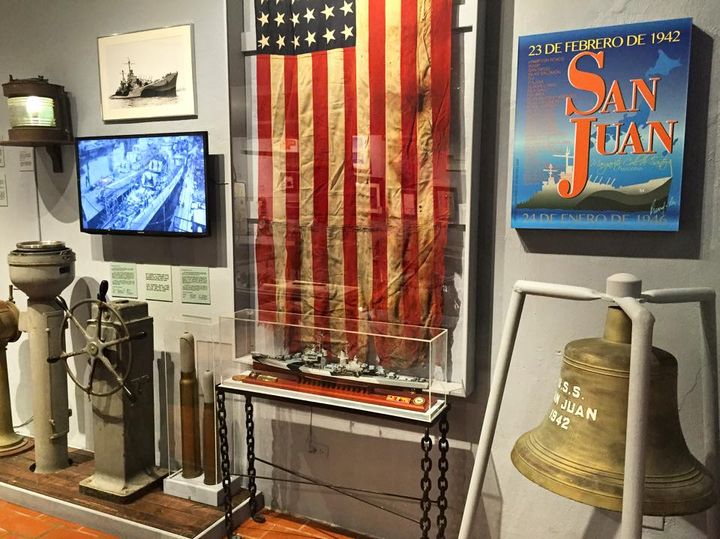
USS San Juan exhibit at the San Juan Maritime Museum
II. World War II:
One of the bloodiest and most destructive conflicts in history, World War II lasted six years, from 1939 to 1945, though it had been set into motion long before then. This war involved most of the world’s nations, including the Allied (United States, Great Britain, and the Soviet Union) and Axis powers (Germany, Italy and Japan). In 1933, Adolf Hitler came to power, leading to an increase in the persecution of Germany’s Jewish citizens. On August 31, 1939, Hitler ordered the hostile takeover of Poland, starting the chain of events that led to the eventual declaration of war, on September 3rd, as Britain and France rushed to Poland’s defense. From here, the war started, and it only escalated. The Holocaust and the first uses of the atomic bomb were some of the major events that occurred throughout. 1
III. Puerto Rico’s Involvement in WWII:
Puerto Rico has always had a rocky relationship with its status as territory. The longest standing colony in the world, Puerto Rico has faced over 500 years of colonial rule. After the Americans took control of the island from the Spanish in the Spanish-American War of 1898, there was a big shift in the common feeling toward the United States. That is still present today: the island has distinct political parties highlighting the different interests of the people. While some would like independence, others believe the island should state, or should remain under the colonial label (though, “the Commonwealth” wasn’t established until 1952, post-WWII). But, even then, with so many different views on the status of the island and other issues within, when the news of the war spread, our people were ready to help. It can be estimated that about 72,000 Puerto Ricans aided in the war effort. 2
Many different people stepped forward to serve, joining the U.S. Army, Navy, and other branches of the military, ready to defend their homeland. One of the most notable contributions came from the 65th Infantry Regiment, specifically “The Borinqueneers,” the U.S. military’s only all-Hispanic unit, mostly from Puerto Rico, hence the name (deriving from Borinquen or Boriken, the Taino name for the island).3
Thirteen months after Pearl Harbor, the 65th Infantry Regiment was deployed to the Panama Central Zone, where they were tasked with guarding the Panama Canal and other vital installations.4 Later, in 1944, they were sent to North Africa in preparation for the invasion of Europe, where they fought with distinction in the Italian Campaign, among other battles. In North Africa, Col. Antulio Segarra became the first Puerto Rican officer to command a regiment in the Regular U.S. Army. In October 1944, the 65th Infantry Regiment was assigned to the Seventh Army to help defeat German forces in southern France and end the war.5
Back on the island, the war had sparked a change in Puerto Rican society. Factories started opening up across the island, while military infrastructure was being built up. There was an influx of war-related activities across the island. However, although there was somewhat of an economic development, the war also brought about rationing, blackouts, and the constant threat of enemy attacks (which, unfortunately, was a very common occurrence). German U-boats dominated the Caribbean, sinking ships and disrupting trade, but, even then, the people of Puerto Rico endured these challenges, proving their strength and valor.6

Transport ship John Erickson entering San Juan Bay on Friday, November 9, 1945. Onboard is the returning 65th Infantry Regiment from the combat front.
IV. The USS San Juan:
The USS San Juan was a major vessel named after the capital city of Puerto Rico. It was technically the second ship of its name, but the first to hold relation to the island. The ship played an important role in the U.S. Navy during WWII, and serves as a symbol of the contributions and involvement of Puerto Rico in the war effort.7
Commissioned in 1942, the USS San Juan was an Atlanta-class light cruiser, designed for versatile operations, primarily focused on anti-aircraft capabilities. This ship participated in multiple different critical campaigns and battles in the Pacific.8 One of the USS San Juan’s first major engagements was the Battle of the Santa Cruz Islands in October 1942, which was a part of the larger Guadalcanal Campaign, aimed in aiding the Allies in their battles of the Pacific. Following this battle, the USS San Juan continued serving across the Pacific, for example, in the Aleutian Islands Campaign, which provided support in the many assaults that were a part of the U.S. “island-hopping” strategy (built on mainly targeting the less defended and surveyed islands over the heavily fortified ones as a way to take over enemy territories). Toward the end of the war, the ship supported the invasions of Iwo Jima and Okinawa, two of the bloodiest battles in the Pacific, and even entered the Tokyo Bay, where the formal surrender of Japan was signed aboard the USS Missouri in 1945.9
The presence of the USS San Juan in the war served as a reminder of the valor and sacrifice of the Puerto Rican people throughout. The USS San Juan earned 13 battle stars for its service in World War II, reflecting its distinguished combat record. After the war, the ship was decommissioned in 1946 and sold for scrap. Its legacy is remembered today, as a testament to the bravery and resilience of its crew as well as of the Puerto Rican people who fought both in and outside of the island– like the Borinqueneers, who played a major role in the war.
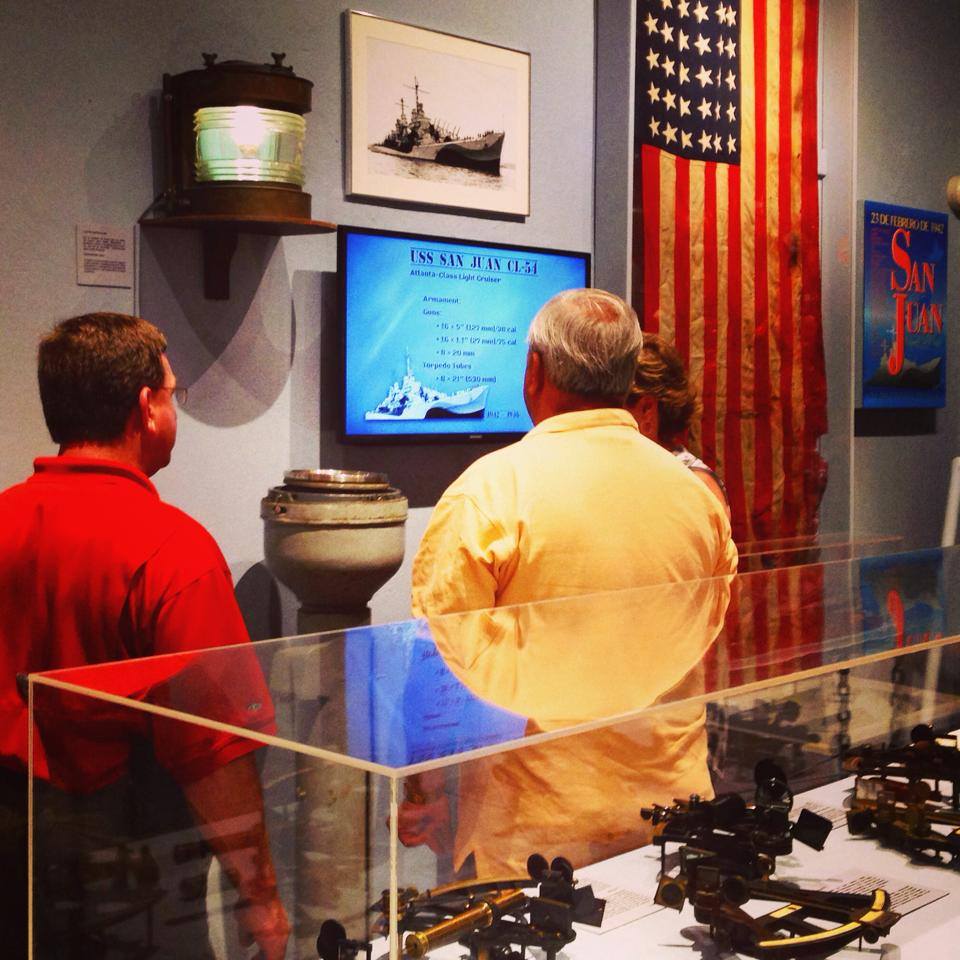
Visitors at the Maritime Museum of San Juan enjoying the USS San Juan exhibit.
V. Conclusion:
Puerto Rico’s involvement in WWII is something that should genuinely be discussed more. Growing up, I’d never heard of just how much the island really had to add to the war effort, and I think it’s so crucial to highlight our involvement in such a massive world issue. If it wasn’t for all those Boricuas who had risked their lives in the war, some of the battles may have been lost. Even if the fight was small in comparison to other major WWII events, every little bit counts, and, I’m almost certain that if I dig deeper into the spiral of Puerto Rican involvement in WWII (and even WWI, and other global conflicts, like those of the Cold War), I’ll find so many different stories of this time that many people will probably not have even heard of.
Knowing our history is incredibly important, and seeing ourselves represented throughout different periods helps shape the identity we are so proud of. The Maritime Museum does a great job of bringing together different artifacts and information about naval history in general, but also, of Puerto Rico’s own stories and history. I would have never known much about the island’s involvement in WWII had I not started working here, so I hope I’ve at least inspired you to try and learn more about Puerto Rico’s history in some of the major world conflicts and issues such as this one. Even more, if you’re visiting the island or are from the area, I encourage you to come and stop by the museum. Explore our exhibits, and feel free to ask questions.
About the Author
Marisa de la Villa is currently in her third year at Boston University, where she expects to graduate with a Bachelor’s degree in History. From a young age, she has enjoyed the sea, spending summers on her grandfather’s sailboat. She obtained her diving license at the age of 10 and her navigation license at 15. As a history student, she understands the importance of ships throughout time. Marisa is currently volunteering at the Museo del Mar in San Juan, Puerto Rico.
Notes
- Onion, Amanda, Missy Sullivan, Matt Mullen, and Christian Zapata. “World War II: Summary, Combatants & Facts.” History.com.
- The puerto rican philly experience · 1940-45: 72,000 Puerto Ricans serve during WWII · HSP Exhibits.
- Román, Ivan. “Puerto Rico’s 65th Infantry Fought Bravely in Korea-Then Had to Fight for Redemption.” History.com.
- “The 65th Infantry Regiment.” National Museum of the United States Army.
- Ibid.
- “Puerto Rico during World War II: Strategic Importance, Contributions, and Societal Changes,” West Side Destination
- Naval encyclopedia, “Atlanta Class Light Cruisers (1941),” naval encyclopedia
- Ibid.
- United States Navy, San Juan II (CL-54)
Bibliography
Encyclopedia, Author: naval. “Atlanta Class Light Cruisers (1941).” naval encyclopedia, April 24, 2023. https://naval-encyclopedia.com/ww2/us/atlanta-class-light-cruisers.php.
Onion, Amanda, Missy Sullivan, Matt Mullen, and Christian Zapata. “World War II: Summary, Combatants & Facts.” History.com. Accessed August 25, 2024. https://www.history.com/topics/world-war-ii/world-war-ii-history.
“Puerto Rico during World War II: Strategic Importance, Contributions, and Societal Changes.” West Side Destination, August 15, 2023. https://wsdestination.com/2023/08/17/puerto-rico-world-war-2/.
Román, Ivan. “Puerto Rico’s 65th Infantry Fought Bravely in Korea-Then Had to Fight for Redemption.” History.com. Accessed August 25, 2024. https://www.history.com/news/puerto-rico-65th-infantry-borinqueneers.
The puerto rican philly experience · 1940-45: 72,000 Puerto Ricans serve during WWII · HSP Exhibits. Accessed August 25, 2024. https://omeka.hsp.org/s/puertoricanphillyexperience/page/puertoricansinww2#:~:text=Puerto%20Rico%20and%20its%20people,naval%20base%2C%20called%20Roosevelt%20Roads.
“The 65th Infantry Regiment.” National Museum of the United States Army. Accessed August 25, 2024. https://www.thenmusa.org/articles/the-65th-infantry-regiment/.
United States Navy, San Juan II (CL-54). Accessed August 25, 2024. https://www.history.navy.mil/content/history/nhhc/research/histories/ship-histories/danfs/s/san-juan-ii.html.